Table of Contents
Solar System Overview
Our Solar System revolves around the Sun, a yellow dwarf star at the centre of our planetary neighbourhood. The system consists of eight recognised planets, divided into two main categories: terrestrial (inner) planets and gas giants (outer planets), separated by the asteroid belt.
The four terrestrial or inner planets have dense, rocky compositions, few or no moons, and no ring systems. They are mainly composed of refractory minerals such as silicates, which form their crusts and mantles, and metals like iron and nickel, which form their cores. Three of the four inner planets (Venus, Earth, and Mars) have atmospheres substantial enough to generate weather.
The four outer planets, also called giant planets or Jovian planets, collectively make up 99% of the mass known to orbit the Sun. Jupiter and Saturn together form more than 400 times the mass of Earth and consist overwhelmingly of hydrogen and helium, hence their designation as gas giants. Uranus and Neptune are far less massive, less than 20 Earth masses each, and are composed primarily of ices, leading some astronomers to classify them in their category as “ice giants.” All four giant planets have ring systems, although only Saturn’s rings are easily observed from Earth.
Planets in Order
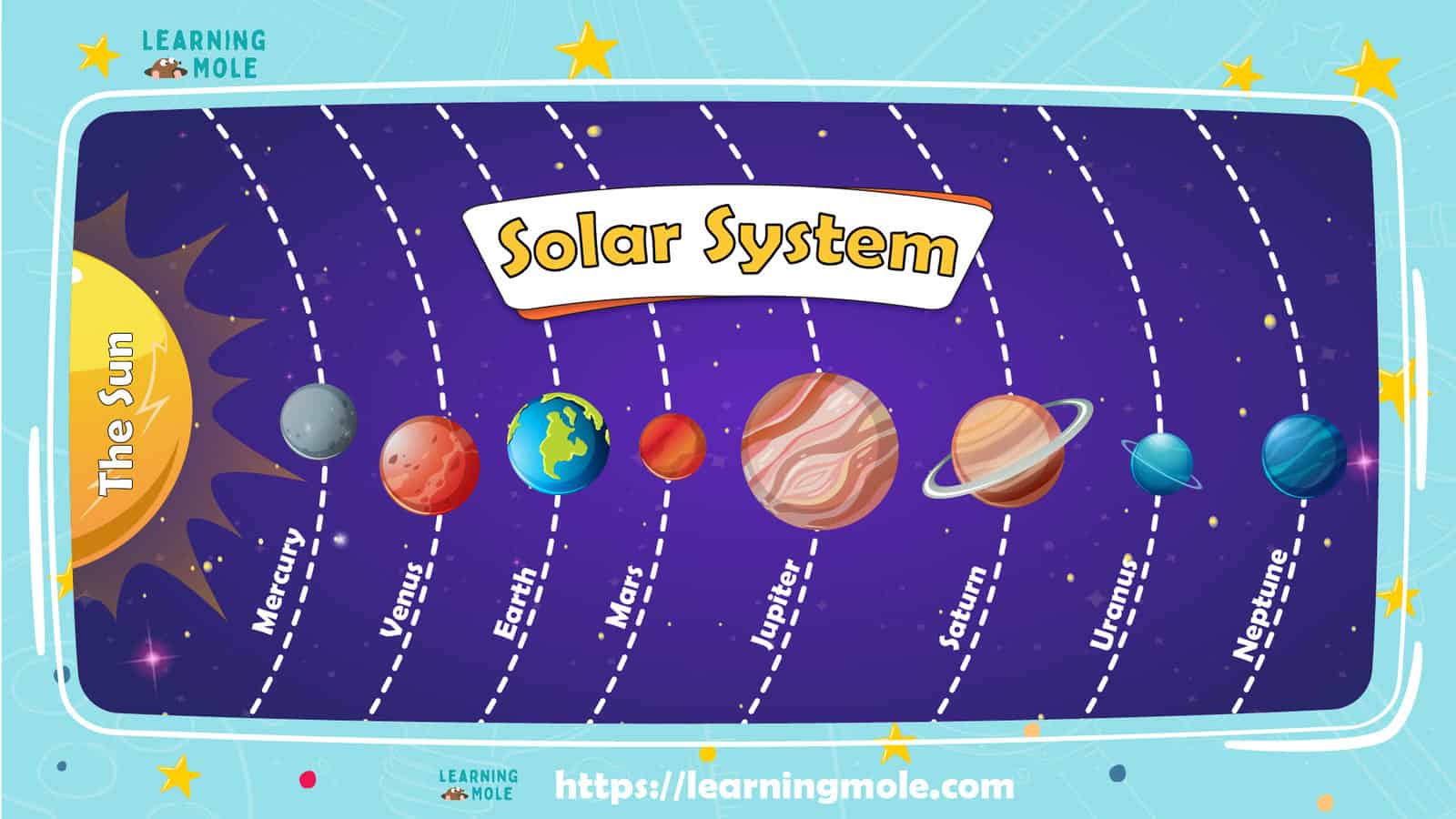
If you ask most people to name all the planets, they can usually recall them with some effort. However, remembering the correct Solar System order can be more challenging. The current order of planets from the Sun is Mercury, Venus, Earth, Mars, Jupiter, Saturn, Uranus, and Neptune.
The solar system is divided into two main parts: the inner planets and the outer planets, separated by a band of rocks and dust scattered in space known as the asteroid belt. The inner planets (Mercury, Venus, Earth, and Mars) are relatively small, rocky worlds with few or no moons. The outer planets (Jupiter, Saturn, Uranus, and Neptune) are much larger gas giants with numerous moons and ring systems.
The Solar System Order Details:
| Planet | Distance from Sun (million km) | Diameter (km) | Size relative to Earth | Key Features |
|---|---|---|---|---|
| Mercury | 57.9 | 4,879 | 38% | Smallest planet, closest to Sun, extreme temperature variations |
| Venus | 108.2 | 12,104 | 95% | Earth’s “sister,” hottest planet (~430°C), thick CO₂ atmosphere |
| Earth | 149.6 | 12,742 | 100% | Our home planet, only known world with life, has one moon |
| Mars | 227.9 | 6,780 | 53% | Our home planet, the only known world with life, has one moon |
| Jupiter | 778.3 | 139,822 | 1120% | Largest planet, Great Red Spot, at least 79 moons, faint rings |
| Saturn | 1,429.4 | 116,464 | 945% | Second-largest planet, spectacular ring system, 82+ moons |
| Uranus | 2,871.0 | 50,724 | 400% | Tilted 98° on its axis, 27 known moons, faint rings |
| Neptune | 4,504.3 | 49,244 | 388% | Windiest planet, 14 moons, discovered by mathematical prediction |
The Sun, at the centre of our Solar System, dwarfs all the planets combined. With a diameter of 1,391,016 km, it is approximately 109 times the size of Earth. By volume, the Sun is about 1.3 million times bigger than Earth—approximately 1.3 million Earths could fit inside the Sun. Within the Sun, there is about 99.86% of all the mass of the Solar System.
The Terrestrial Planets
The four inner planets of our Solar System—Mercury, Venus, Earth, and Mars—are known as terrestrial planets because they have solid, rocky surfaces similar to Earth’s terrain. Let’s explore each of these fascinating worlds in more detail.
1. Mercury: The Swift Planet
Mercury is the smallest planet in our Solar System and the closest to the Sun.
Key Facts:
- Orbit time: 88 Earth days
- Day length: 59 Earth days
- Diameter: 4,879 km (3,032 miles)
- Temperature range: -173°C to 427°C (-280°F to 800°F)
Mercury has a tenuous atmosphere, which means, despite being the closest planet to the Sun, it cannot retain heat well. This results in extreme temperature variations, with scorching days and freezing nights. Its surface is heavily cratered, resembling our Moon. NASA’s MESSENGER probe, launched in 2004, significantly increased our knowledge of this small world.
Mercury’s proximity to the Sun makes it challenging to observe from Earth, as it’s often lost in the Sun’s glare. The best times to view it are shortly after sunset or before sunrise, when it appears as a bright star-like object near the horizon.
2. Venus: Earth’s Toxic Twin
Venus is the second planet from the Sun and is often called Earth’s sister due to its similar size and structure.
Key Facts:
- Orbit time: 225 Earth days
- Day length: 243 Earth days (longer than its year!)
- Diameter: 12,104 km (7,521 miles)
- Average temperature: 462°C (864°F)
Venus has the hottest surface of any planet in our Solar System, with temperatures that could melt lead. Its thick atmosphere is primarily carbon dioxide with clouds of sulfuric acid, creating an extreme greenhouse effect. The atmospheric pressure on Venus’s surface is 92 times that of Earth, equivalent to being 900 metres underwater on our planet.
Venus rotates in the opposite direction to most planets, meaning on Venus, the Sun rises in the west and sets in the east. It’s the brightest natural object in Earth’s night sky after the Moon, sometimes visible even in daylight if you know where to look.
3. Earth: Our Home Planet
Earth is the third planet from the Sun and the only known world to support life.
Key Facts:
- Orbit time: 365.25 days
- Day length: 24 hours
- Diameter: 12,742 km (7,918 miles)
- Average surface temperature: 15°C (59°F)
Earth is unique in many ways—it has liquid water on its surface, a protective atmosphere with enough oxygen to support complex life, and a magnetic field that shields us from harmful solar radiation. Our planet has one natural satellite, the Moon, which influences Earth’s tides and stabilises our axial tilt, giving us relatively consistent seasons.
Earth’s four distinct seasons are caused by our planet’s 23.5-degree axial tilt, which means that different parts of the Earth receive varying amounts of direct sunlight throughout the year as we orbit the Sun.
4. Mars: The Red Planet
Mars is the fourth planet from the Sun and the last of the terrestrial planets.
Key Facts:
- Orbit time: 687 Earth days
- Day length: 24.6 hours (a “sol”)
- Diameter: 6,779 km (4,212 miles)
- Temperature range: -87°C to 20°C (-125°F to 70°F)
Mars is known for its distinctive red appearance caused by iron oxide (rust) in its soil. It has a thin atmosphere, mainly consisting of carbon dioxide, and is home to both the highest mountain (Olympus Mons) and the deepest, longest canyon (Valles Marineris) in our Solar System.
Mars has two small moons, Phobos and Deimos, which were likely captured asteroids. Evidence suggests that Mars once had flowing water on its surface billions of years ago, raising the possibility that it might once have harboured life. Currently, it’s the only planet exclusively inhabited by robots—various rovers and landers that scientists have sent to study its surface.
The Gas Giants
Beyond the asteroid belt lie the four giant planets of our Solar System: Jupiter, Saturn, Uranus, and Neptune. Unlike the rocky inner worlds, these planets are composed primarily of hydrogen and helium, with no solid surfaces to stand on.
5. Jupiter: The King of Planets
Jupiter is the fifth planet from the Sun and by far the largest in our Solar System.
Key Facts:
- Orbit time: 12 Earth years
- Day length: 9.93 hours
- Diameter: 139,822 km (86,881 miles)
- Composition: Mainly hydrogen and helium
Jupiter is a massive gas giant with a mass 2.5 times that of all other planets combined. Its most famous feature is the Great Red Spot, a giant storm that has been raging for at least 400 years. This enormous planet has at least 79 moons, with the four most extensive—Io, Europa, Ganymede, and Callisto—often called the Galilean moons after their discoverer.
Jupiter’s magnetic field is the strongest of any planet, approximately 14 times stronger than Earth’s. This creates intense radiation belts that would be lethal to humans. Despite its size, Jupiter has the shortest day of any planet, rotating once every 10 hours.
6. Saturn: The Ringed Wonder
Saturn is the sixth planet from the Sun and perhaps the most visually striking due to its spectacular ring system.
Key Facts:
- Orbit time: 29.5 Earth years
- Day length: 10.7 hours
- Diameter: 116,464 km (72,367 miles)
- Notable feature: Extensive ring system
Saturn’s rings are made mostly of ice particles with a smaller amount of rocky debris and dust. Although they extend up to 282,000 km from the planet, they’re surprisingly thin—in most places, no more than 10 metres thick. Saturn has at least 82 moons, with Titan being the largest and the only moon in our Solar System with a substantial atmosphere.
Interestingly, Saturn has such a low density that it would float in water if you could find a bathtub large enough. It’s also known for its hexagonal cloud pattern at its north pole, a unique feature not seen on other planets.
7. Uranus: The Sideways Planet
Uranus is the seventh planet from the Sun and the first to be discovered through a telescope.
Key Facts:
- Orbit time: 84 Earth years
- Day length: 17.2 hours
- Diameter: 50,724 km (31,518 miles)
- Unique feature: Rotates on its side
Uranus is unique among the planets as it rotates on its side, with its axis tilted nearly 98 degrees. This gives it extreme seasons, with each pole experiencing 42 years of continuous daylight followed by 42 years of darkness. The planet appears blue-green due to methane in its atmosphere, which absorbs red light and reflects blue.
Uranus has 27 known moons, all named after characters from Shakespeare and Alexander Pope’s works. It also has a system of rings, although they’re much fainter than Saturn’s.
8. Neptune: The Windy World
Neptune is the eighth and most distant planet from the Sun.
Key Facts:
- Orbit time: 165 Earth years
- Day length: 16.1 hours
- Diameter: 49,244 km (30,599 miles)
- Notable feature: Strongest winds in the Solar System
Neptune is known for its intense blue colour, which is also caused by atmospheric methane. It experiences the strongest winds in our Solar System, with speeds reaching up to 2,100 km/h (1,300 mph). Neptune has 14 known moons, the largest of which is Triton, which orbits the planet in the opposite direction to Neptune’s rotation.
Neptune was the first planet to be predicted mathematically before it was actually observed. Irregularities in Uranus’s orbit led astronomers to calculate the position of an unknown planet that was affecting it gravitationally. Neptune was discovered in 1846, exactly where mathematicians had predicted it would be.
Multiple Classification Systems
Planets Arranged by Size (Diameter):
- Jupiter (139,822 km)
- Saturn (116,464 km)
- Uranus (50,724 km)
- Neptune (49,244 km)
- Earth (12,742 km)
- Venus (12,104 km)
- Mars (6,780 km)
- Mercury (4,879 km)
Planets Arranged by Mass:
- Jupiter (1.8986 × 10²⁷ kg)
- Saturn (5.6846 × 10²⁶ kg)
- Neptune (1.0243 × 10²⁶ kg)
- Uranus (8.6810 × 10²⁵ kg)
- Earth (5.9736 × 10²⁴ kg)
- Venus (4.8685 × 10²⁴ kg)
- Mars (6.4185 × 10²³ kg)
- Mercury (3.3022 × 10²³ kg)
Planets Arranged by Density (g/cm³):
- Earth (5.52)
- Mercury (5.43)
- Venus (5.24)
- Mars (3.93)
- Neptune (1.64)
- Jupiter (1.33)
- Uranus (1.32)
- Saturn (0.69)
Planets Arranged by Gravity (m/s²):
- Jupiter (23.1)
- Neptune (11.0)
- Earth (9.8)
- Saturn (9.0)
- Venus (8.9)
- Uranus (8.7)
- Mars (3.7)
- Mercury (3.7)
Planets Arranged by Length of Day (hours):
- Mercury (4222.6)
- Venus (2802.0)
- Mars (24.7)
- Earth (24.0)
- Uranus (17.2)
- Neptune (16.1)
- Saturn (10.7)
- Jupiter (9.9)
Teaching Solar System Concepts
For Early Years (Ages 3-5)
The Solar System can seem abstract to very young children, but you can make it tangible through simple, engaging activities:
- Solar System Mobiles: Create a hanging model of the planets using different-sized balls.
- Planet Sorting Cards: Use picture cards to help children recognise each planet by its distinctive appearance.
- Sun-Centred Play: Set up activities where one child represents the Sun while others orbit around as planets.
“Early years education should spark wonder about our place in the universe,” says Michelle Connolly, founder of LearningMole. “Young children naturally ask big questions about space, and we can nurture that curiosity through playful exploration of the planets.”
For Key Stage 1 (Ages 5-7)
Build on a basic understanding with more structured learning:
- Planet Size Comparisons: Use fruits of different sizes to represent planets (e.g., peppercorn for Mercury, watermelon for Jupiter).
- Order Games: Create floor mats with planets that children can arrange in the correct order.
- Day and Night Model: Use torches and balls to demonstrate how Earth’s rotation creates day and night.
- Simple Mnemonic Learning: Teach the classic “My Very Eager Mother Just Served Us Noodles” mnemonic.
For Key Stage 2 (Ages 7-11)
Introduce more complex concepts and encourage independent research:
- Scale Model Solar System: Calculate and create a to-scale model in the playground or hall.
- Planet Fact Files: Have pupils research and create detailed profiles of each planet.
- Gravity Experiments: Use different weighted balls to demonstrate how gravity varies across planets.
- Cross-Curricular Links: Connect to English through space-themed creative writing or to maths through calculating distances using scientific notation.
For Secondary School (Ages 11+)
Deepen knowledge with more advanced concepts:
- Orbital Mechanics: Explore Kepler’s laws of planetary motion and how they describe planetary orbits.
- Comparative Planetology: Study the similarities and differences between planets and what they tell us about planetary formation.
- Research Projects: Investigate current space missions exploring the Solar System.
- Digital Modelling: Use software like Stellarium to model the movements of planets.
Remembering the Planets
One of the challenges for students learning about our Solar System is remembering the correct order of the planets. Teachers and parents can use various mnemonics—memory aids—to help children recall the sequence. Here are several effective mnemonics for the order of planets from the Sun:
Traditional Mnemonics
The most common mnemonic for remembering the order of planets (Mercury, Venus, Earth, Mars, Jupiter, Saturn, Uranus, Neptune) is:
“My Very Eager Mother Just Served Us Noodles”
Other popular variations include:
- “My Very Easy Method Just Speeds Up Naming”
- “My Very Educated Mother Just Served Us Nachos”
- “My Very Excellent Mother Just Sent Us Nine” (when Pluto was considered a planet)
Creating Personalised Mnemonics
Encourage students to create their mnemonics as this process itself enhances memory:
- Relevant interests: For a child interested in sports, create “Many Valuable Expeditions Made Jordan Score Unlimited Numbers”
- Funny scenarios: Humorous mnemonics are often more memorable
- Alliteration: “Mercury Moves, Venus Ventures, Earth Evolves…” etc.
Visual Memory Techniques
Beyond word-based mnemonics, visual techniques can be highly effective:
- Planet models: Creating physical models where planets are placed in order
- Colour associations: Linking each planet with a distinctive colour in sequence
- Size progression: Visualising the planets arranged by their relative sizes
“Children learn in different ways, and finding the right memory technique can make all the difference,” explains Michelle Connolly, founder of LearningMole. “While some respond well to verbal mnemonics, others connect more deeply with visual or hands-on approaches to learning the planets’ order. The key is making it personally meaningful.”
Fascinating Solar System Facts
Mercury
- Has a tenuous atmosphere and experiences extreme temperature variations (−173°C to 427°C)
- A day on Mercury (sunrise to sunrise) lasts 176 Earth days
- Despite being closest to the Sun, it’s not the hottest planet (Venus is)
Venus
- Rotates backwards compared to other planets
- Has a thick atmosphere, creating a runaway greenhouse effect
- Surface pressure is 92 times that of Earth, equivalent to being 900m underwater
Earth
- The only planet known to support life
- Has the perfect balance of elements and conditions for liquid water
- Our magnetic field protects us from harmful solar radiation
Mars
- Home to Olympus Mons, the highest mountain in the Solar System (about three times the height of Mount Everest)
- Has dust storms that can cover the entire planet
- Evidence suggests it once had flowing water on its surface
Jupiter
- Has the Great Red Spot, a storm that has been raging for at least 400 years
- Emits more heat than it receives from the Sun
- Has the strongest magnetic field of any planet
Saturn
- Has the most extensive ring system, made primarily of ice particles
- Would float in water if you could find a bathtub large enough (due to its low density)
- Its moon, Titan, has lakes of liquid methane and a thick atmosphere
Uranus
- Tilted on its side with its axis of rotation nearly in the plane of its orbit
- Appears blue-green due to methane in its atmosphere
- Experiences extreme seasons due to its tilt
Neptune
- Has the strongest winds in the Solar System (up to 2,100 km/hour)
- It was mathematically predicted before being observed
- Its moon Triton orbits in the opposite direction to Neptune’s rotation
Why Are All Planets Round?
All planets are round because of gravity. When the Solar System was forming, gravity gathered billions of pieces of gas and dust into clumps that grew larger and larger to become the planets. The force of gravity pulled this material toward the planet’s centre, forming a sphere.
However, planets aren’t perfectly spherical. Their rotation causes them to bulge slightly at the equator, making them technically oblate spheroids rather than perfect spheres. This effect is most noticeable on Jupiter.
Which Planet Has the Strongest Winds?
Neptune has the strongest winds in the Solar System. Winds whip clouds of frozen methane across the planet at speeds of more than 2,100 km/hour (1,200 mph)—close to the top speed of a fighter jet. For comparison, the most powerful winds on Earth reach only about 400 km/hour (250 mph).
What Is the Largest Moon in the Solar System?
Jupiter’s moon Ganymede is the largest in the Solar System, with a diameter of 5,268 km (3,270 miles), making it larger than the planet Mercury. It has a rocky core with a water/ice mantle and a rock and ice crust. Ganymede has mountains, valleys, craters, and ancient lava flows.
How Did the Planets Get Their Names?
All planets, except Earth, were named after Roman gods and goddesses:
- Mercury: Roman messenger god
- Venus: Roman goddess of love and beauty
- Earth: From English/German words meaning “ground”
- Mars: Roman god of war
- Jupiter: King of the Roman gods
- Saturn: Roman god of agriculture
- Uranus: Greek god of the sky (father of the Titans)
- Neptune: Roman god of the sea
How Many Planets Have Rings?
All four outer planets (Jupiter, Saturn, Uranus, and Neptune) have ring systems. Saturn’s magnificent rings are easily visible from Earth with a small telescope, but the rings of the other gas giants are much fainter and were only discovered during space missions in the 1970s and beyond.
How Do Planets Stay in Orbit?
The solar system is formed from a rotating cloud of gas and dust. As this cloud collapsed, most of the material gathered at the centre to form the Sun, while some remained in a flattened disk that eventually formed the planets. The planets continue to orbit because:
- They have momentum that would make them travel in a straight line
- The Sun’s gravity pulls them inward
- These two forces balance perfectly, creating stable elliptical orbits
Without the Sun’s gravity, the planets would fly off into space. Without their momentum, they would fall into the Sun.
Frequently Asked Questions
Why do the planets have different colours?
Planets have different colours due to what they’re made of and how their surfaces or atmospheres reflect sunlight:
- Mercury: Dark grey surface covered with silicate rocks and dust
- Venus: Yellowish appearance due to a thick carbon dioxide atmosphere and sulphuric acid clouds
- Earth: Blue oceans, white clouds, green and brown landmasses
- Mars: Orange-red colour from iron oxide (rust) in its surface dust
- Jupiter: Bands of white, orange, brown and red from various chemicals in its atmosphere
- Saturn: Yellowish-brown from ammonia, phosphine, water vapour and hydrocarbons in its atmosphere
- Uranus: Blue-green from methane gas in its atmosphere
- Neptune: Deep blue, also from methane in its atmosphere
Which planet has the strongest winds?
Neptune has the strongest winds in the Solar System, reaching speeds of more than 2,100 km/hour (1,300 mph). This is close to the top speed of a fighter jet! For comparison, the most powerful winds recorded on Earth (in tornadoes) reach only about 400 km/hour (250 mph).
What is the largest moon in the Solar System?
Ganymede, one of Jupiter’s moons, is the largest in the Solar System. With a diameter of 5,268 km (3,270 miles), it’s larger than the planet Mercury. Ganymede has a rocky core with a water/ice mantle and a crust of rock and ice, featuring mountains, valleys, craters, and ancient lava flows.
Which planet spins the fastest?
Jupiter is the fastest-spinning planet, completing one rotation in just under 10 hours. This rapid rotation causes the planet to bulge at its equator, which rotates slightly faster than its polar regions, at approximately 43,000 km/hour (28,273 mph).
Where is the highest mountain in our solar system?
Olympus Mons on Mars is the highest mountain and volcano in the Solar System. It stands about 24 km (16 miles) high, making it roughly three times higher than Mount Everest. Besides being extraordinarily tall, it’s also enormous in area, covering a region larger than the entire Hawaiian island chain.
Are moons always smaller than planets?
Moons are always smaller than the planets they orbit because a more petite body naturally orbits a larger one due to gravitational forces. However, not all moons are smaller than all planets. Seven moons in our Solar System (including Earth’s Moon) are larger than the dwarf planet Pluto. Ganymede and Titan (Saturn’s largest moon) are both larger than Mercury.
How do the planets stay in orbit around the sun?
The planets stay in orbit due to a perfect balance between two forces:
- Inertia: The tendency of the planets to move in a straight line through space
- Gravity: The Sun’s gravitational pull, which constantly tugs the planets toward it
These balanced forces result in the planets following elliptical orbits around the Sun. They stay in these orbits because there’s no significant force in the Solar System that can stop them.
How did the planets get their names?
All planets except Earth were named after Roman gods and goddesses:
- Mercury: Named after the swift messenger of the gods
- Venus: Named after the goddess of love and beauty
- Earth: Derived from English/German words meaning “ground”
- Mars: Named after the god of war
- Jupiter: Named after the king of the Roman gods
- Saturn: Named after the god of agriculture
- Uranus: Named after the ancient Greek deity of the sky
- Neptune: Named after the god of the sea
- Pluto (dwarf planet): Named after the god of the underworld
Understanding the Solar System helps students grasp fundamental concepts in physics, chemistry, and mathematics while inspiring wonder about our place in the universe. For teachers and parents, LearningMole offers comprehensive resources to support Solar System education at all levels—from early years picture books to advanced secondary school materials that align with curriculum requirements.
Our educational videos bring planetary science to life with age-appropriate explanations and stunning visuals, while our downloadable worksheets provide opportunities for assessment and reinforcement of key concepts. Visit LearningMole’s subscription service to access our complete library of space science materials.
<p>The post The Amazing Facts of Solar System Order: A Complete Teaching Guide first appeared on LearningMole.</p>





