Table of Contents
Kangaroos Facts for Kids: Have you ever seen a kangaroo hopping across the ground and wondered how such a large animal can bounce so effortlessly? Or thought about those adorable baby kangaroos peeking out of their mother’s pouch and asked yourself how they got in there in the first place? Kangaroos are some of the most unique and fascinating animals on our planet, and they’re full of surprises that will absolutely amaze you!
These incredible creatures are found only in Australia and a few nearby islands, making them one of the most special animals in the world. With their powerful legs, distinctive hopping movement, and that famous pouch where they carry their babies, kangaroos have captured the imaginations of people around the globe. They’ve become symbols of Australia itself, appearing on coins, emblems, and even airline logos!
But kangaroos are much more than just cute animals that hop around. They’re incredibly adapted to survive in some of the harshest environments on Earth, they have unique ways of communicating with each other, and their babies go through one of the most remarkable journeys in the animal kingdom. From their super-powered jumping abilities to their fascinating social lives, kangaroos are creatures that deserve our attention and admiration.
In this article, we’re going to explore five captivating facts about kangaroos that will help you understand why these marsupials are so extraordinary. Whether you’re working on a school report, planning a trip to Australia someday, or just love learning about amazing animals, these facts will give you a whole new appreciation for these hopping wonders. So let’s leap right into the wonderful world of kangaroos!
Fact 1: Kangaroos Are Amazing Jumpers

When it comes to jumping, kangaroos are true champions of the animal kingdom! These incredible creatures can leap to heights of up to 10 feet in the air – that’s taller than most basketball hoops! Even more impressively, they can jump forward distances of up to 30 feet in a single bound. That’s longer than a school bus is wide! Imagine being able to jump from one end of your classroom to the other in just one hop – that’s the kind of amazing ability kangaroos have.
The secret to a kangaroo’s jumping superpower lies in their unique body structure. Their back legs are incredibly powerful and muscular, built like natural springs. These legs contain some of the strongest muscles in the animal kingdom relative to body size. When a kangaroo prepares to jump, it crouches down, compressing these powerful leg muscles. Then, when it releases that energy, the kangaroo explodes upward and forward in a graceful arc. It’s like having two powerful pogo sticks built right into their body!
But kangaroos aren’t just good at jumping high and far – they’re also remarkably fast. When a kangaroo really gets moving, it can reach speeds of 35 miles per hour, and some large male red kangaroos have been recorded hopping at speeds up to 44 miles per hour for short bursts! That’s faster than most people can drive through a neighbourhood. To put this in perspective, the fastest human sprinter in the world, Usain Bolt, can run at about 28 miles per hour at his absolute top speed. Kangaroos can hop faster than the fastest human can run!
What makes kangaroo jumping even more remarkable is how efficient it is. You might think that hopping everywhere would use up a lot of energy, but for kangaroos, it’s actually the most energy-efficient way to travel. When kangaroos hop at medium speeds, they use less energy than if they tried to walk or run on all fours like other animals. This is because of special elastic tendons in their legs that store and release energy with each bounce, kind of like a rubber band being stretched and released. The faster they go (up to a certain speed), the more efficient the hopping becomes. It’s like they have built-in energy recycling!
Now, let’s talk about a kangaroo’s tail, because it’s not just there for decoration – it’s actually crucial to their jumping ability. A kangaroo’s tail is incredibly strong and muscular, and it works as a “fifth leg” that helps with balance and movement. When a kangaroo is hopping quickly, the tail acts as a counterbalance, swinging in the opposite direction to the body to help the kangaroo maintain stability in the air. It’s like a tightrope walker using a long pole for balance.
When kangaroos are moving slowly or standing still, they use their tail even more interestingly. They can actually use their tail and front paws together to form a tripod, lifting their powerful hind legs off the ground completely. This allows them to move around slowly while grazing or to kick with their back legs if they need to defend themselves. Some scientists have found that when kangaroos move slowly like this, their tail does as much work as a leg – it pushes against the ground and supports the animal’s weight. So it really is like having a fifth leg!
Different species of kangaroos have different jumping abilities based on their size. The large red kangaroo, which is the biggest kangaroo species, is the most powerful jumper. Grey kangaroos are also impressive jumpers. Smaller wallabies (which are relatives of kangaroos) can’t jump quite as high or as far, but they’re incredibly agile and can make quick, sharp turns that larger kangaroos can’t manage. Each species has evolved its jumping ability to match its environment and lifestyle perfectly.
Fact 2: Baby Kangaroos (Joeys) Are Born Incredibly Tiny

Get ready for one of nature’s most amazing facts: when a baby kangaroo is born, it’s smaller than a jellybean! That’s right – these tiny creatures are only about one inch long at birth, roughly the size of your thumbnail. They’re pink, hairless, blind, and so underdeveloped that they look more like little gummy bears than the robust kangaroos they’ll eventually become. To put this in perspective, a newborn joey weighs less than one gram, while an adult red kangaroo can weigh up to 200 pounds. That’s an incredible transformation!
But here’s where the story gets even more remarkable. Despite being so tiny and helpless, a newborn joey has to make an incredible journey immediately after birth. Using only its front legs (which are slightly more developed than its back legs at this stage), the jellybean-sized baby must climb through its mother’s fur, travelling from the birth canal all the way up to the pouch on her belly. This journey is only about 6-8 inches long, but for something so small and undeveloped, it’s like climbing Mount Everest!
The mother kangaroo doesn’t help with this climb – she simply sits in a position that makes the journey possible, licking a path through her fur that the joey can follow. The baby kangaroo uses its sense of smell and instinct to make this incredible climb, pulling itself forward with its tiny front arms. The whole journey usually takes about 3-5 minutes, and it’s truly one of nature’s most amazing accomplishments. Scientists who have filmed this journey are always amazed that something so tiny and undeveloped can successfully make this climb on its very first attempt!
Once the joey reaches the pouch, it latches onto one of the mother’s four teats (nipples) inside. The teat actually swells inside the joey’s mouth, creating a secure attachment so the baby can’t accidentally fall off. For the next several months, the joey will stay attached to this teat, drinking its mother’s milk and growing rapidly in the safe, warm environment of the pouch. The mother kangaroo’s milk is incredibly nutritious and changes in composition as the joey grows, providing exactly what the baby needs at each stage of development.
The joey will stay inside the pouch for about 6-8 months for most kangaroo species, though this varies depending on the species. During this time, the joey grows fur, develops its eyes and ears, and becomes more recognisable as a kangaroo. Around 4-5 months old, the joey might start briefly peeking its head out of the pouch to look around at the world. By 6 months, it might stick its whole head out, and you might even see its ears and face poking out regularly.
Eventually, the joey will make its first exit from the pouch, usually around 6-8 months old. But this doesn’t mean it’s independent! For several more months, the joey will return to the pouch for milk, warmth, and safety whenever it feels scared or tired. You might see a large joey with its legs dangling out of the pouch because it’s gotten too big to fit completely inside, but it still wants the comfort of being close to mom. Joeys typically stop using the pouch entirely when they’re around 10-12 months old, but they’ll stay close to their mothers for several more months after that.
Here’s another incredible fact about kangaroo reproduction: mother kangaroos can actually pause a pregnancy! This amazing ability is called embryonic diapause. If a mother kangaroo already has a joey in her pouch and she gets pregnant again, the new embryo will only develop to a very early stage (about 100 cells) and then pause its development.
It will stay paused until the older joey leaves the pouch permanently or until environmental conditions are right for a new baby. Once the pouch is empty or conditions improve, the paused embryo will resume development and be born about 30 days later. This means a mother kangaroo can have three offspring at different stages: a joey at her feet that has left the pouch, a younger joey in the pouch, and a paused embryo waiting for its turn. Talk about amazing family planning!
Fact 3: Kangaroos Can’t Walk Backwards

Here’s a captivating fact that many people find surprising: kangaroos cannot walk backwards! That’s right – these amazing hoppers can only move forward. But why is this the case? The answer lies in the unique structure of their bodies, which are perfectly designed for forward movement but make reverse movement essentially impossible.
A kangaroo’s body is built in a very specific way. They have enormously powerful hind legs and large feet that point forward, a heavy and muscular tail, and relatively small front legs. When you put all these features together, they create a body that’s like a living catapult designed to launch forward, but this same design makes it impossible for them to move backwards in a normal way.
Think about it this way: when a kangaroo is standing normally, its large tail rests on the ground behind it, forming a tripod with its two back legs. The tail is incredibly strong and heavy – it can weigh 30-40 pounds in a large kangaroo! This tail acts like a permanent kickstand that props up the body. To walk backwards, a kangaroo would need to lift this heavy tail and somehow push backwards with its powerful hind legs, but the shape and structure of these legs simply don’t allow for that kind of movement. The knees and ankles are built to extend forward powerfully, not to push backwards.
Additionally, a kangaroo’s hind feet are very long and large (to provide stability during landing), and they naturally point forward. The tendons and muscles in a kangaroo’s legs are all oriented to create forward propulsion. There’s simply no mechanism in their leg structure that would allow them to reverse the direction of force. It would be like trying to make a car go backwards when it only has forward gears!
This unique characteristic has made the kangaroo an important symbol in Australian culture. Along with the emu (another Australian bird that also cannot walk backwards), the kangaroo appears on Australia’s national coat of arms. These two animals were chosen specifically because they can only move forward, which symbolises a nation that’s always progressing and moving forward, never backwards. It’s a powerful message about always looking ahead to the future!
So what does a kangaroo do when it needs to change direction or turn around? They have a few options. When moving slowly and grazing, kangaroos can use their tail as a fifth leg to support their weight while they lift and reposition their hind legs one at a time, allowing them to pivot their body. When they’re hopping quickly, they simply make forward curved jumps, essentially hopping in an arc to change direction. They might need to make several hops to completely turn around, but they manage just fine!
In water, however, the rules change! Kangaroos are actually good swimmers, and when they’re swimming, they can move their legs independently and even paddle backwards if needed. This is because water supports their weight differently and allows them to move their legs in ways they can’t on land. But on solid ground, forward is the only direction they’re designed to go.
Some other animals also have this limitation of not being able to walk backwards easily. Emus, as mentioned, cannot walk backwards. Ostriches also have difficulty moving backwards. Even some birds like flamingos find it very difficult to walk backwards. However, kangaroos are probably the most famous example of this characteristic, and certainly the only major mammal that’s completely unable to reverse direction on land!
Fact 4: Kangaroos Are Social Animals with Unique Communication
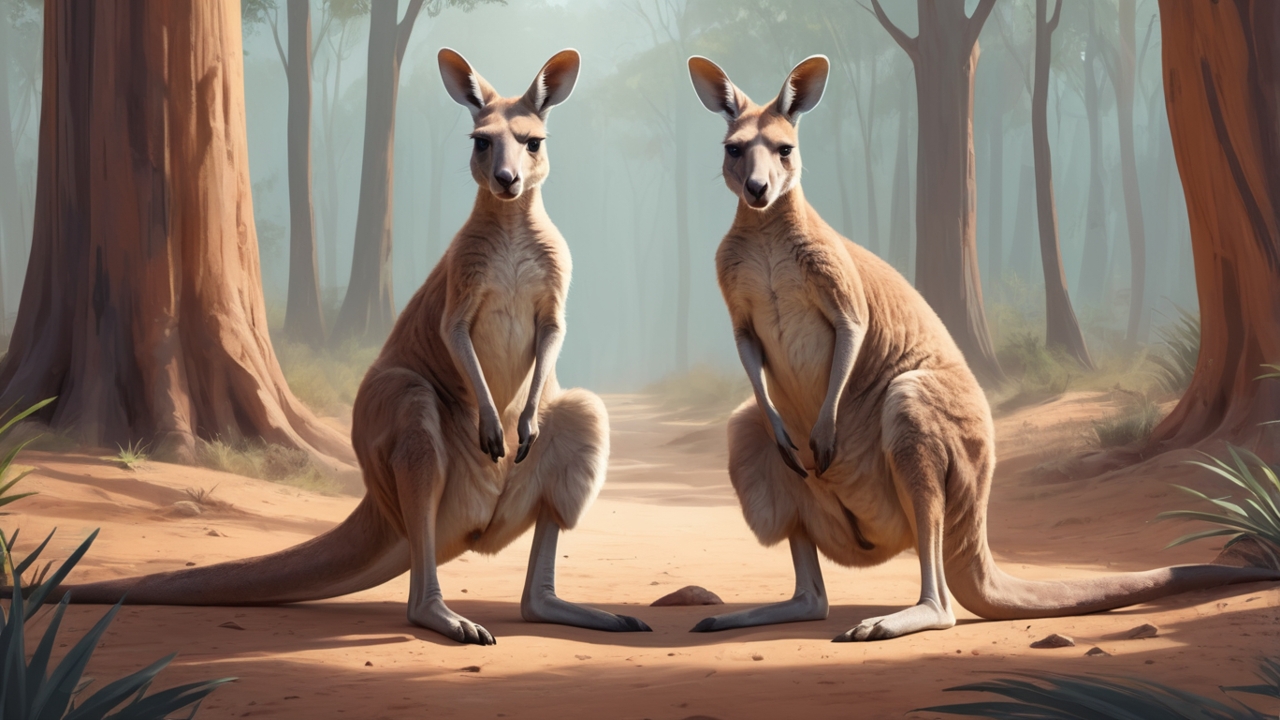
While many people know what kangaroos look like, fewer people know about their rich social lives and the interesting ways they communicate with each other. Kangaroos are highly social animals that live in groups called “mobs” (sometimes also called “troops” or “herds”). A typical mob consists of anywhere from 10 to 50 kangaroos, though in areas with lots of food and water, you might see groups of over 100 kangaroos gathered together!
Within these mobs, kangaroos have developed fascinating social structures and relationships. A mob typically consists of several females and their joeys, along with multiple males of different ages and social ranks. The females often form the stable core of the group, staying together for long periods, while males might move between different mobs.
Despite the changing membership, kangaroos recognise each other as individuals and develop social bonds, especially between mothers and their offspring. Female joeys often stay with their mothers for extended periods, even after becoming independent, sometimes forming lifelong associations.
Kangaroos communicate with each other in several interesting ways. One of the most common forms of communication is foot stomping. When a kangaroo senses danger, it will thump its large hind foot against the ground, creating a loud thumping sound that alerts all the other kangaroos in the area. This alarm call sends the entire mob into high alert, and they’ll all stop what they’re doing to look around for the threat. The foot thump can be heard from quite a distance and is an effective way to warn the whole group without making a sound that might attract the predator’s attention directly to the caller.
Kangaroos also make various vocalisations, though they’re generally quieter animals than you might expect. They can produce coughing sounds, clucking noises, and soft growling or hissing when they’re annoyed or defensive. Mother kangaroos and their joeys have special soft clicking calls they use to communicate with each other. A mother might make gentle clicking sounds to call her joey back to her side, and the joey will respond with similar sounds. These quiet calls help them stay connected even when grazing in tall grass where they might not always be able to see each other.
One of the most famous kangaroo behaviours is “boxing.” You might have seen videos or cartoons of kangaroos standing up on their hind legs and appearing to box with each other like human fighters. This isn’t just for show – it’s a real behaviour that male kangaroos use to establish dominance and compete for mating rights with females. When two males want to determine who’s stronger, they’ll face each other, balance on their tails, and use their front paws to grab, push, and strike at each other. They also kick with their powerful hind legs, which can deliver incredibly strong blows.
These boxing matches might look comical to us, but they’re serious business for kangaroos. A large male red kangaroo can stand over 6 feet tall and weigh up to 200 pounds of pure muscle. When these giants box, it’s an impressive display of strength. However, most boxing matches don’t result in serious injuries. They’re more about demonstration and establishing hierarchy.
Once one male clearly dominates the other, the loser will usually retreat, and the winner gains higher social status and better access to females. Serious fights with major injuries are relatively rare because it’s not in either kangaroo’s best interest to get badly hurt.
Social grooming is another important form of communication and bonding in kangaroo mobs. Kangaroos will groom each other by licking and nuzzling, especially mothers grooming their joeys. This behaviour strengthens social bonds and helps maintain group cohesion. Grooming also serves a practical purpose of removing parasites and keeping fur clean, but the social aspect is just as important.
Kangaroos also communicate through body language. The position of their ears, the way they hold their head, and their overall posture all convey information to other kangaroos. A kangaroo that feels threatened might stand tall with ears forward, making itself look as large and intimidating as possible. A relaxed kangaroo will have a more casual posture with ears in a neutral position. Young joeys learn to read these signals from an early age, helping them understand the social dynamics of their mob.
The social bonds within a mob provide important benefits for all members. There’s safety in numbers – with many pairs of eyes and ears watching for danger, the group is much more likely to spot predators early. Joeys learn important survival skills by watching and interacting with other kangaroos. And during the harsh Australian summers, having a group means that knowledge about water sources and good grazing areas can be shared among members. Being social isn’t just about companionship for kangaroos – it’s a crucial survival strategy!
Fact 5: Kangaroos Are Built to Survive the Australian Outback

The Australian Outback is one of the harshest environments on Earth – scorching hot during the day, sometimes freezing at night, with limited water sources and sparse vegetation. Yet kangaroos thrive in this challenging landscape because they’ve evolved remarkable adaptations that allow them to survive where many other animals would struggle. These adaptations are a testament to just how amazing and resilient kangaroos really are!
One of the most impressive adaptations is the kangaroo’s ability to survive with very little water. In the dry Australian interior, water sources can be far apart and unreliable. Kangaroos have adapted to this challenge in several ways. First, they can go for long periods without drinking water at all – sometimes for months!
They get much of the moisture they need from the plants they eat, particularly fresh green grasses and leaves that contain water. Their kidneys are incredibly efficient at concentrating urine, which means they lose very little water when they need to urinate. This is similar to how camels survive in deserts, though kangaroos have developed this ability independently.
When it comes to food, kangaroos are also remarkably efficient. They’re herbivores with a specialised digestive system somewhat similar to that of cows. Their stomach has multiple chambers where food is fermented by bacteria, allowing kangaroos to extract maximum nutrition from tough, fibrous grasses that many other animals couldn’t digest well. This means they can survive on relatively low-quality food that’s available even during droughts. During really tough times when food is scarce, kangaroos can slow down their metabolism, reducing the amount of energy and food they need to survive.
Temperature regulation is another major challenge in the Australian Outback, where daytime temperatures regularly exceed 100°F (38°C) in summer. Kangaroos have developed several clever ways to stay cool. One of the most interesting is their habit of licking their forearms. Kangaroos have a network of blood vessels very close to the skin’s surface on their forearms, and when they lick these areas, the evaporating saliva cools the blood flowing through these vessels.
This cooled blood then circulates throughout the body, helping to lower the kangaroo’s overall body temperature. It’s like having a built-in air conditioning system! In extreme heat, you might see kangaroos licking their forearms frequently, keeping them wet and cool.
Kangaroos also modify their behaviour to cope with heat. They’re primarily nocturnal and crepuscular, which means they’re most active during the night and at dawn and dusk when temperatures are cooler. During the hottest part of the day, kangaroos rest in the shade, often lying down in shallow depressions they dig in the ground where the soil is cooler. They minimise their movement during hot hours to conserve water and energy. This behavioural adaptation is just as important as their physical adaptations in helping them survive extreme temperatures.
Kangaroos have excellent senses that help them survive in their environment. Their large ears can rotate independently, allowing them to pinpoint sounds from any direction without moving their heads. This helps them detect predators like dingoes, eagles, and once upon a time, thylacines (Tasmanian tigers). Their eyes are positioned on the sides of their heads, giving them a wide field of vision so they can watch for danger while grazing. They also have an excellent sense of smell that helps them find water sources and detect predators from a distance.
Different species of kangaroos have adapted to different Australian environments, showing remarkable diversity. Red kangaroos live in the dry inland plains and are the largest and toughest, able to survive the harshest conditions. Eastern and western grey kangaroos prefer areas with more trees and slightly more rainfall. Tree kangaroos (yes, they exist!) have adapted to life in the rainforests of northern Australia and New Guinea, developing strong forearms for climbing and longer tails for balance. Antilopine kangaroos live in the tropical north. Each species has fine-tuned its survival strategies to match its specific environment.
Kangaroos also have the ability to time their reproduction to environmental conditions. During severe droughts when food and water are scarce, female kangaroos can delay joey development or even stop reproduction entirely to conserve energy. When conditions improve and rain brings fresh grass, reproduction picks up again. This ability to respond to environmental conditions ensures that joeys are born when they have the best chance of survival, and mothers aren’t depleting their resources trying to raise babies during impossible conditions.
Kangaroos Facts Conclusion

Isn’t it incredible how much there is to discover about kangaroos? From their amazing jumping abilities that make them look like they’re bouncing on springs, to the remarkable journey tiny joeys must make to reach their mother’s pouch, to their inability to walk backwards, to their complex social lives and communication methods, to their impressive adaptations for surviving in one of the world’s harshest environments – kangaroos are truly extraordinary animals that deserve our admiration and respect.
These remarkable marsupials have evolved over millions of years to become perfectly suited to life in Australia. Every aspect of their biology and behaviour, from their powerful legs and elastic tendons to their efficient kidneys and behavioural thermoregulation, tells a story of adaptation and survival. They’ve found ways to thrive in conditions that would challenge most other mammals, and they’ve done it with a grace and efficiency that’s simply beautiful to watch.
Kangaroos have become more than just animals – they’re symbols of Australia itself, representing the unique and wonderful wildlife found nowhere else on Earth. They appear in Aboriginal rock art thousands of years old, showing that humans have been fascinated by these animals since ancient times. Today, they’re recognised worldwide as icons of Australian identity and natural heritage.
However, kangaroos face challenges in the modern world. While some species have large populations, others are threatened by habitat loss, climate change, vehicle collisions, and other human impacts. Tree kangaroos are particularly vulnerable, with some species critically endangered. Conservation efforts are working to protect kangaroo habitats and ensure these amazing animals will continue to hop across the Australian landscape for generations to come.
If you want to learn more about kangaroos, there are many exciting ways to do so! You could watch nature documentaries that show kangaroos in their natural habitat – seeing them hop across the Outback at sunset is truly breathtaking. Many zoos around the world have kangaroos and wallabies, and some even offer opportunities to meet them up close (though remember, wild animals should always be treated with respect, even in zoo settings). You could read more books about Australian wildlife, draw or paint kangaroos, or even start a school project about how different animals adapt to extreme environments.
Australia is home to over 50 species of kangaroos and their relatives (wallabies, wallaroos, pademelons, and tree kangaroos), each with its own unique characteristics and adaptations. Learning about these different species can teach you about evolution, ecology, and the amazing diversity of life on our planet.
The next time you see a picture of a kangaroo or a video of one hopping across the plains, you’ll be able to appreciate the incredible biology and behaviour behind what you’re seeing. You’ll understand the power in those legs, the remarkable journey that Joey took to reach his mother’s pouch, the social bonds within the mob, and the countless adaptations that allow these animals to survive and thrive in challenging conditions.
So go ahead – share these captivating facts with your friends, family, and classmates! Teach them about kangaroo boxing and joey journeys and the amazing fact that kangaroos can’t walk backwards. The more people understand and appreciate these magnificent marsupials, the more we’ll all want to protect them and their habitats. After all, a world without kangaroos hopping across the Australian Outback would be a much less wonderful and much less captivating place!
If you enjoyed learning about these fascinating animals, why not check out more fantastic facts about other animals: Raccoons, Pandas, endangered animals, and Whales.
Why not subscribe to our LearningMole Library for as little as £1.99 per month to access over 3400 fun educational videos.
<p>The post Kangaroos Facts for Kids – 5 Captivating Facts about Kangaroos first appeared on LearningMole.</p>