Table of Contents
Albert Bandura’s Social Learning Theory revolutionised the understanding of how people learn within a social context, making it a pivotal concept in the realm of education. This theory posits that learning is a cognitive process that takes place in a social environment and can occur purely through observation or imitation. In the dynamic environment of a classroom, it highlights the significance of role models and the influential power of observing peers and teachers.

In applying Social Learning Theory to educational settings, teachers become facilitators of social interaction and create an environment conducive to observational learning. It builds upon the idea that students acquire knowledge through direct instruction and watching others, thus learning behaviours and outcomes of actions.
This underscores the importance of providing positive role models and encouraging environments that reinforce good behaviour and learning participation. By understanding and utilising this theory, educators can enhance student motivation, self-efficacy, and educational outcomes.
Understanding Social Learning Theory
In this exploration of Social Learning Theory, you’ll discover the framework for understanding how learning occurs through observation and interaction in social contexts. Albert Bandura’s extensive work in this field has dramatically shifted our perception of learning processes.
Key Components and Principles
Social Learning Theory combines cognitive learning theory and observational learning, underscoring the importance of both observing and modelling the behaviours, attitudes, and emotional reactions of others. Central to this theory are several core principles:
- Observation: Individuals can learn by watching the behaviours of others and the outcomes of those behaviours.
- Imitation: Much of what is learned is gained through imitation. After observing a model, individuals may also imitate behaviours that have been demonstrated.
- Modelling: Learning can occur through direct instruction or live models, such as parents, peers, or teachers, as well as symbolic models, like characters in books or media.
- Reinforcement and Punishment: Behaviours are likely to be repeated if they are reinforced. Alternatively, behaviours may not be repeated if they are punished or not rewarded.
Through these components, Social Learning Theory emphasises that learning is a cognitive process that takes place in a social context.
Bandura’s Contributions
Albert Bandura, a renowned psychologist, significantly contributed to our understanding of cognitive learning theory and its application in educational settings. He proposed that cognitive factors, environmental influences, and behavioural factors interact to influence learning—a notion known as reciprocal determinism.
Bandura’s concept of observational learning suggests that people can learn through watching others and then replicating those actions. His famous “Bobo Doll” experiments highlighted how children learn and mimic behaviours they have witnessed.
Michelle Connolly, a founder and educational consultant with a rich 16-year history in the classroom experience, emphasises the practicality of Bandura’s work, stating, “Bandura’s theory reshaped the way we think about learning. It’s the cornerstone of understanding and facilitating learning through models in our classrooms today.”
The Role of Observation in Learning
Observation is pivotal in shaping how you acquire and hone new skills and behaviours. Through careful observation of models, you can dissect and understand complex actions.
Different Types of Models
Live Models: When you’re in a classroom, observing a live model, such as a teacher or a peer, can be a powerful way of learning. You might watch your teacher solve a complex equation on the board or witness a classmate skilfully present a speech. Here, attention and retention are key, as you need to focus on the model’s behaviour and remember it for future reproduction.
Symbolic Models: In today’s connected world, you’re likely also to encounter symbolic models. These can be characters in books, narratives or even individuals represented in various media sources. A symbolic model might teach through storytelling, allowing you to absorb the lesson more narratively. Although not physically present, these models can still influence your learning by providing a point of reference for behaviour and thought processes.
Looking at these models, whether live or symbolic, you learn through observation. Observational learning isn’t passive; it requires active engagement. Pay attention to the nuances of the task at hand, store this information effectively, and later reproduce the behaviour or skill when needed. Your capability to learn through observation can be further enhanced when the observed behaviour is followed by positive outcomes, reinforcing your desire to replicate the model’s actions.
Michelle Connolly, the founder of LearningMole, emphasises that “Observation is the starting block for learning. It’s not just about seeing; it’s about decoding and understanding actions within a context.” With her 16 years of classroom experience, Connolly recognises the critical nature of using various models to capture the essence of learning through observation.
Motivation and Reinforcement

Understanding motivation and reinforcement is key to applying Bandura’s social learning theory, which focuses on affecting student behaviour and learning.
Dynamics of Reinforcement
In your classroom, the role of reinforcement—positive, like praise or corrective feedback—is crucial in shaping students’ actions and attitudes towards learning. Positive reinforcement can increase the likelihood of a desired behaviour reoccurring by giving rewards. For instance, awarding points for participation can encourage continued engagement.
Conversely, punishment, such as loss of privileges, can decrease undesired behaviours. However, effective teaching recognises that reinforcement strategies should align with individual student needs to promote consistent motivational processes.
Intrinsic vs. Extrinsic Motivation
Moving on to motivation, it’s necessary to differentiate between the drivers that come from within the student (intrinsic motivation) and those that are provided externally (extrinsic motivation). When students are intrinsically motivated, their drive to engage and excel in the classroom is because of personal satisfaction or a desire to master a skill. On the other hand, extrinsic motivation might involve striving for a reward or recognition. Michelle Connolly, founder and educational consultant at LearningMole, with 16 years of classroom experience, says, “When students find personal meaning and relevance in the material, intrinsic motivation takes the front seat, leading to a more profound and sustainable learning experience.”
Integrating both forms of motivation can lead to a balanced learning environment in your teaching practice, catering to differing student needs and encouraging a more robust learning outcome.
Practical Applications in the Classroom
When considering the application of Bandura’s Social Learning Theory in the classroom, it’s vital to create an environment conducive to observed learning, exemplify positive behaviour, and effectively reinforce accomplishments.
Creating Effective Learning Environments
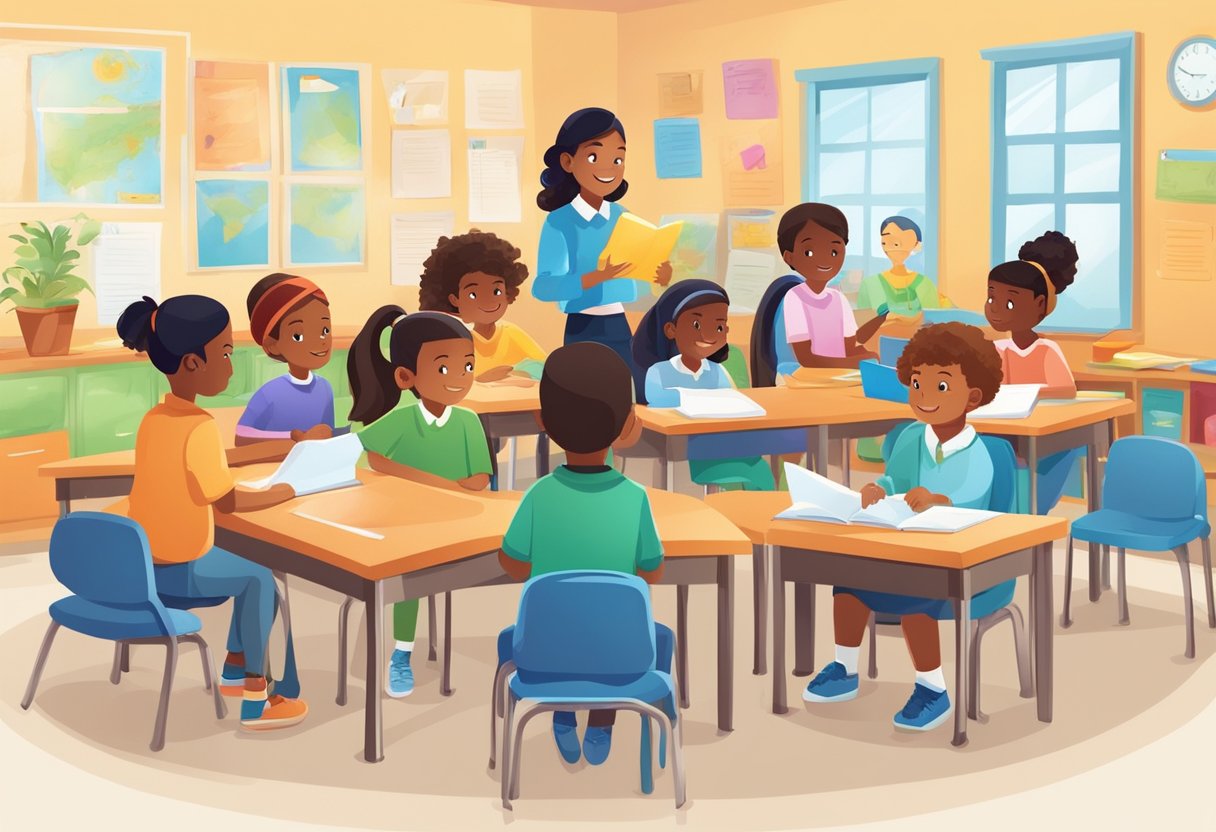
Your classroom should be a dynamic learning space that encourages observation and interaction. Set up your classroom to facilitate group work and discussions, allowing students to witness and model each other’s behaviours. This kind of setup enhances learning through observation and fosters peer collaboration, which is a key facet of Bandura’s theory.
Role of the Teacher as a Model
As a teacher, you are a pivotal role model. Demonstrate the behaviours and attitudes you expect from your students. Use clear and consistent verbal instruction, and pair these with actions that reinforce the lessons you’re teaching. Remember, your pupils will look to you to understand how to act and respond in various situations. “Students observe teachers every day and learn from them whether they are intentional about it or not,” says Michelle Connolly, a founder at LearningMole.
Praising and Rewarding Behaviours
Effective feedback and reinforcements are crucial for learning. Make a habit of offering praise for both effort and achievement. Be specific with your feedback; this helps students understand what they did correctly and reinforces the behaviour. Rewards can be verbal praise, but can also be class points or tokens, which serve as tangible evidence of success, encouraging students to continue engaging in the desired behaviour.
Influencing Behaviour Through Role Models

In the classroom, the behaviours and attitudes of role models are paramount in shaping student learning, both academically and socially. Understanding the dynamics of this influence is crucial for positive development.
Selecting Appropriate Role Models
When choosing role models within the classroom, it’s essential to present individuals who exhibit prosocial behaviour, which aligns with the desired outcomes of social learning. These role models might be historical figures, current public figures, or even peers within the classroom environment who demonstrate qualities such as kindness, perseverance, and cooperation.
Michelle Connolly, an expert with 16 years of teaching experience, suggests that “The role models we present to our students can profoundly impact their attitudes and actions; it’s vital to choose individuals who embody the virtues we aim to instil.”
Impact of Media on Behaviour
The media serves as a powerful source of role models, with its ability to expose children to a variety of behaviours and social contexts. The content consumed can significantly influence both positive and negative behavioural patterns. As teachers, steering students towards media that supports behaviourist learning theories and promotes positive role models is essential. This can be achieved by guiding discussions about media content critically and encouraging students to identify and emulate positive behaviours.
Impact of Environment on Social Learning

Your learning environment can significantly affect your grasp of social cognitive theory. Carefully crafted learning spaces that align with this theory can encourage positive development and foster an engaged social context.
Social and Educational Contexts
Your social environment profoundly influences how you learn. In environments rich with interaction and observation, such as those advocated by Albert Bandura’s social cognitive theory, you’re more likely to assimilate new behaviours and concepts. The theory posits that learning is a cognitive process that takes place in a social context and can occur purely through observation or instruction, without any direct reinforcement.
Educational settings have begun implementing the flipped classroom model, in which traditional learning environments are inverted. Instructional content is accessed outside the classroom, and hands-on activities are integrated into class time, providing a rich environment for social learning. Positive psychology plays a vital role in shaping educational settings. Learning environments that focus on students’ strengths and well-being can lead to better engagement and higher achievement.
Michelle Connolly, founder of LearningMole, emphasises the significance of environment saying, “A positive environment is not only about bright walls and comfortable seats, it’s about crafting spaces that inspire learning and collaboration.” With her 16 years of classroom experience, Michelle understands that the right environment can be the difference between a student merely attending class and truly engaging with the material.
Your environment is more than just your physical space; it’s a blend of emotional and social factors that contribute to your development during the learning process.
Understanding and Addressing Deviant Behaviour
When you’re dealing with deviant behaviour in the classroom, it’s essential to understand the underlying factors and employ effective strategies to address the issues. This section will explore how conditioning plays a pivotal role in behaviour modification.
Role of Conditioning in Behaviour Modification
Conditioning is a fundamental concept originally derived from the theories of Social Learning. It suggests that behaviour can be learned and modified through a process of reinforcement and consequences. In a classroom setting, teachers can address behavioural issues by rewarding positive behaviour, which encourages its repetition, and applying appropriate consequences to discourage deviant or criminal behaviour.
For example, “Children often mimic both good and bad behaviour that they see,” states Michelle Connolly, an educational consultant with over a decade and a half of classroom experience. This reflection underscores the significance of observational learning in moulding conduct, a core aspect of Bandura’s theory.
Students associate certain behaviours with specific outcomes by consistently applying punishments and rewards. If students experience positive reinforcement when they behave appropriately or show improvement in their behaviour, they are more likely to repeat these actions.
Conversely, understanding the potential impact of consequences is just as important. Rather than simply punishing bad behaviour, it’s crucial to explain the reason behind the punishment, turning it into a learning opportunity that prompts reflection and better choices in the future. Applying this knowledge, you can steer deviant or criminal behaviour towards a more positive trajectory. This approach not only improves individual behaviour but also has the potential to enhance the overall learning environment.
Self-Efficacy and Learning Outcomes
Understanding the relationship between self-efficacy and learning outcomes can be pivotal for educational success. Self-efficacy, defined as one’s belief in one’s ability to achieve goals, has a substantial impact on the level of engagement and achievement within an educational setting.
Building Confidence Through Mastery Experiences
Mastery experiences are seminal avenues for bolstering self-efficacy. When you successfully accomplish a task, especially one that you perceive as challenging, your confidence in your abilities increases. Structured feedback can catalyse this process, pinpointing areas of improvement and reinforcing what has been learnt.
It is important to scaffold these experiences to ensure that the challenge matches your current abilities; this is where feedback plays an essential role. Personalised feedback aids in maintaining attention and supporting memory and recall capabilities. Such experiences are about assessing performance and nurturing self-compassion, recognising one’s efforts, and acknowledging the learning journey.
Michelle Connolly, founder of LearningMole and an educational consultant with over a decade and a half of classroom experience, asserts, “The right feedback can transform a student’s self-belief, turning challenges into stepping stones towards mastery and empowerment in learning.”
By engaging in tasks that align with incremental difficulty levels, you develop skills and build an internal locus of control over learning outcomes. This sense of control and confidence is what fuels the desire to engage with and invest in further learning experiences.
Integrating Social Learning With Other Educational Theories
When incorporating Bandura’s Social Learning Theory into classroom practices, it’s essential to understand how it aligns with and can be integrated into other educational theories. Let’s explore how it can work synergistically with cognitive and behavioural theories and how these integrations can be made engaging through gamification techniques.
Combining with Cognitive and Behavioural Theories
Cognitive theories stress the importance of internal thought processes and how they influence learning. Bandura’s theory aligns with this as it acknowledges the role of cognition in learning from others. Social learning adds a layer to cognitive theories by suggesting that you can learn through observation, not just direct experience. Alignment with behavioural learning theories comes from the shared understanding that the environment can condition behaviour.
However, social learning distinguishes itself by emphasising that imitation and modelling are key mechanisms. For example, when you witness the positive outcomes of a peer’s behaviour, you are more likely to adopt that behaviour yourself, integrating both observational learning and behaviourist elements like reinforcement.
- B.F. Skinner’s work on conditioning can complement social learning in the classroom. To incorporate reinforcement into social learning, use a reward system that acknowledges positive social interactions and group learning successes.
- A balanced approach involves integrating social learning with cognitive and behavioural theories to better understand the learning process. Michelle Connolly, the founder of LearningMole, states, “Effectively integrating theories requires an understanding that learning is both a personal and social process. It’s vital to address the individual’s reasoning and the group dynamics they are part of.”
Gamification and Learning
Gamification entails using game design elements in non-game contexts to enhance user engagement and problem-solving. Social learning can thrive in gamified environments, as the interactive and communal nature of games can mirror social learning’s observational and imitative aspects.
- For instance, in a classroom setting, teams can compete in challenges that reward collaboration, critical thinking, and collective problem-solving, attributes that are at the heart of both gamification and social learning.
- Use leaderboards, points, and badges to motivate and provide feedback. This method introduces an element of behaviourism through positive reinforcement, whilst simultaneously catering to cognitive aspects of learning, as students analyse their performance.
Remember that learning is most effective for every approach in your classroom when it is an active, engaging, and social experience.
Assessment and Reflection in Social Learning
In the realm of education, the role of assessment and reflection becomes pivotal when grounded in Bandura’s Social Learning Theory. These processes allow for the consideration of past experiences, the understanding of reciprocal determinism, and feed into the development of learners.
Evaluating Social Learning in Educational Settings
When you’re assessing social learning, it’s essential to examine the interplay between observation, imitation, and modelling. Reflective techniques and assessments provide a structured pathway for learners to gauge their progress and shape their future actions. It’s also important to consider how students’ experiences and the environment contribute to their learning journey, illustrating the concept of reciprocal determinism.
Evaluating social learning incorporates a variety of strategies. You might:
- Use peer assessments to facilitate reflection on group activities.
- Implement self-assessment tasks that encourage students to reflect on their personal growth.
- Record and analyse discussions to understand social interactions and learning.
As Michelle Connolly, founder of LearningMole, states: “Assessment is not about numbers; it’s about understanding and improving learning through reflection.” Her vast classroom experience backs up this claim, highlighting the importance of assessment in fostering educational development.
Combining ongoing assessment with consistent reflection creates an environment conducive to action and reform. Such a setting mirrors past experiences and sets the stage for further development and learning. Always remember to incorporate assessment and reflection into teaching practices, as they are key components for enhancing the effectiveness of Social Learning Theory in the classroom.
Frequently Asked Questions
Discover how Bandura’s social learning theory can transform your teaching approach and positively impact your students’ learning experiences.
How can educators incorporate Bandura’s concepts of observational learning within lesson plans?
Educators can integrate observational learning into their lesson plans by creating opportunities for students to observe and model behaviours. For instance, video demonstrations of scientific experiments or peer presentations enable students to emulate positive behaviours and understand complex concepts. Michelle Connolly, with her extensive classroom experience, suggests “using role-play scenarios to bring theoretical concepts to life, aiding retention and understanding.”
What are some practical examples of social learning theory being utilised in educational settings?
Social learning theory comes to life when students collaborate on projects, provide peer feedback in writers’ workshops, or participate in group problem-solving sessions. Teachers often facilitate classroom discussions where students can articulate their thoughts and mimic effective communication skills. Connolly affirms, “Group activities are a goldmine for applying social learning, as they reflect real-world social dynamics.”
In what ways does social learning theory inform classroom behaviour management strategies?
This theory supports the idea that positive behaviour can be modelled and rewarded to encourage repetition. In the classroom, teachers can apply these principles by recognising and reinforcing constructive student behaviour, thus setting norms that others will follow. “Effective behaviour management is about setting clear expectations and recognising students when they meet them,” notes Connolly.
How can the principles of social learning theory enhance collaborative activities among students?
Collaborative activities, underpinned by social learning principles, enable students to learn from each other and take responsibility for their learning. When working in groups, students observe their peers’ problem-solving methods and negotiation skills, which improve their teamwork ability. Connolly highlights, “Peer collaboration is a powerful tool, as it provides a social context for conceptual understanding and skill acquisition.”
What are the benefits of adopting Bandura’s social learning theory for students’ academic and social development?
Bandura’s social learning theory facilitates a deeper understanding of academic content and enhances social skills. As students observe and replicate behaviours that lead to success, they develop critical thinking and build confidence. “Academically, it prepares students to tackle complex problem-solving, while socially, it fosters adaptability and empathy,” Connolly reflects.
What methods are effective in applying social learning theory to eLearning environments?
In eLearning environments, interactive simulations, discussion forums, and virtual group work can embody the principles of social learning theory. Encouraging students to discuss and reflect on online content helps to solidify learning and promote digital citizenship. Connolly advises, “Ensure that online platforms are interactive and require students to engage with both the content and their peers to fully utilise the benefits of social learning digitally.”
<p>The post Applying Bandura’s Social Learning Theory in the Classroom: Strategies for Engaging Students first appeared on LearningMole.</p>